Easy Christmas Crochet Patterns for Beginners: 10 Projects You Can Actually Finish
New to crochet and dreaming of a handmade Christmas? Start small, pick projects built from the same few stitches, and plan backwards from the 25th. Here is how, with ten easy ideas.
Save this guide to Pinterest
Every December the same thing happens: we see a tree full of crocheted ornaments, decide to make one ourselves, and pick a pattern that is far too ambitious for the time we have. This guide is about choosing easy Christmas crochet patterns for beginners that you will genuinely finish, with a simple plan for the weeks before the holiday.
What makes a Christmas crochet pattern "easy"?
"Easy" on a pattern listing is subjective, so look for these signs instead:
- Few stitches. Chain, single crochet, increase and decrease cover most small amigurumi. One "special" stitch, like a bobble, is fine if the pattern teaches it.
- Stitch counts on every round. This is how you catch a mistake before it grows.
- One yarn weight and one hook. DK (category 3) yarn with a 3.5 mm hook is a comfortable size for small projects: big enough to see your stitches, small enough to stay neat.
- Small size. An 8 to 10 cm ornament is finished in an evening; a blanket is not.
- Little or no assembly. Patterns described as no sew amigurumi skip the fiddly sewing stage entirely.
- Photos or diagrams for the tricky bits. Especially colour changes and closing the last round.
The 5 skills that unlock almost every Christmas project
- Slip knot and chain: the start of everything.
- Single crochet (sc): the main amigurumi stitch, worked tightly.
- Increase: two sc in one stitch, which makes your circle grow.
- Magic ring: a closed, adjustable start for anything worked in the round. Our magic ring tutorial walks through it step by step.
- Invisible decrease: closes shapes neatly without gaps. See the invisible decrease guide.
Learn these on scrap yarn in one sitting and you can follow every project below.
10 easy Christmas crochet ideas for beginners
The first five are general ideas you will find in many free and paid patterns. The rest are LoopSouk patterns, which we can describe in detail because we wrote them.
1. Flat stars and hearts
Worked flat in a few rounds or rows, these make tree decorations and gift tags. They are the quickest way to practise increases and keeping an edge neat.
2. Simple striped baubles
A ball is the first 3D shape most people learn: increase, work straight, decrease. Stripes teach colour changes without any shaping worries.
3. Mini stockings
A tiny stocking worked in rows is a good bridge between flat and 3D crochet, and can hold a gift card.
4. Granny-square coasters
Red, green and white granny squares make quick table decorations or a gift set, and use up leftover yarn.
5. A basic beanie
If you prefer wearable gifts, a plain beanie in chunky yarn is a classic beginner project. Allow a few evenings rather than one.
6. Three ornaments in one: bauble, snowflake and mini sweater
The LoopSouk crochet Christmas ornament pattern covers a striped bauble about 5 to 6 cm with a hanging loop, a lacy six-point snowflake about 10 cm across after blocking, and a mini sweater. All three use the same DK yarn and 3.5 mm hook.
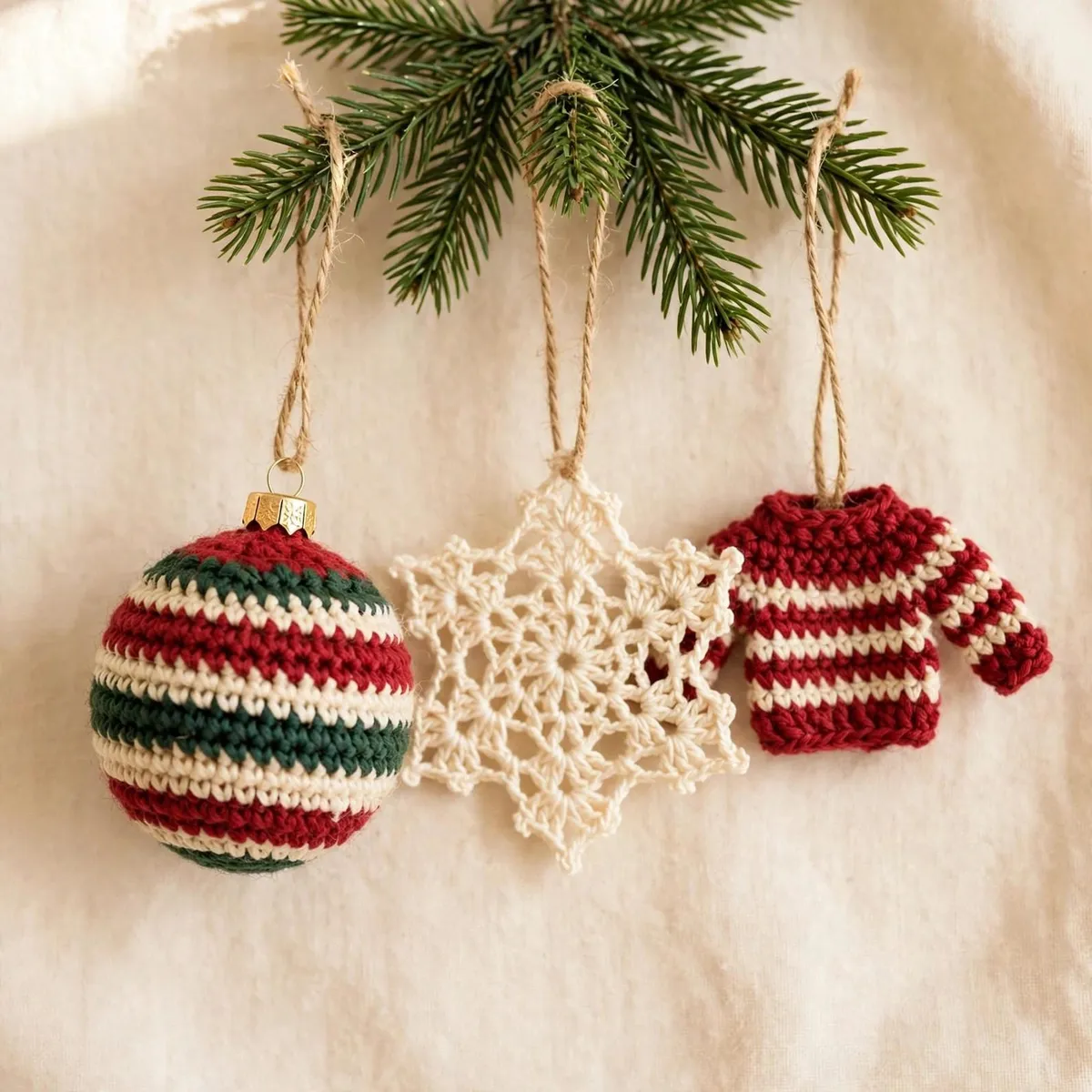
Twinkle Tree Ornaments (3 in 1) · LoopSouk pattern
Twinkle Tree Ornaments: three easy crochet Christmas ornaments in one 19-page PDF. A striped bauble, a six-point snowflake and a mini sweater, all in DK yarn with a 3.5 mm hook.
≈ $3.00 · instant PDF download
7. Pip the mini penguin
A 10 cm no-sew penguin ornament in DK yarn with 6 mm safety eyes. The beak and feet are bobbles, and the pattern includes 8 technique lessons. Read the no sew penguin crochet pattern article.
8. A one-piece reindeer
A Rudolph whose ears and antlers are worked into the rounds, ready to hang on the tree. About 15 to 18 cm in chenille or about 10 cm in DK/worsted. See the no sew reindeer crochet pattern.
9. Mini Christmas tree garland
Five 7.5 cm trees with ornament bobbles worked in, strung on an 80 cm cord for a mantel, wall or tree. The pattern says it plainly: if you can single crochet, you can make it. Read the Christmas tree garland crochet pattern article.
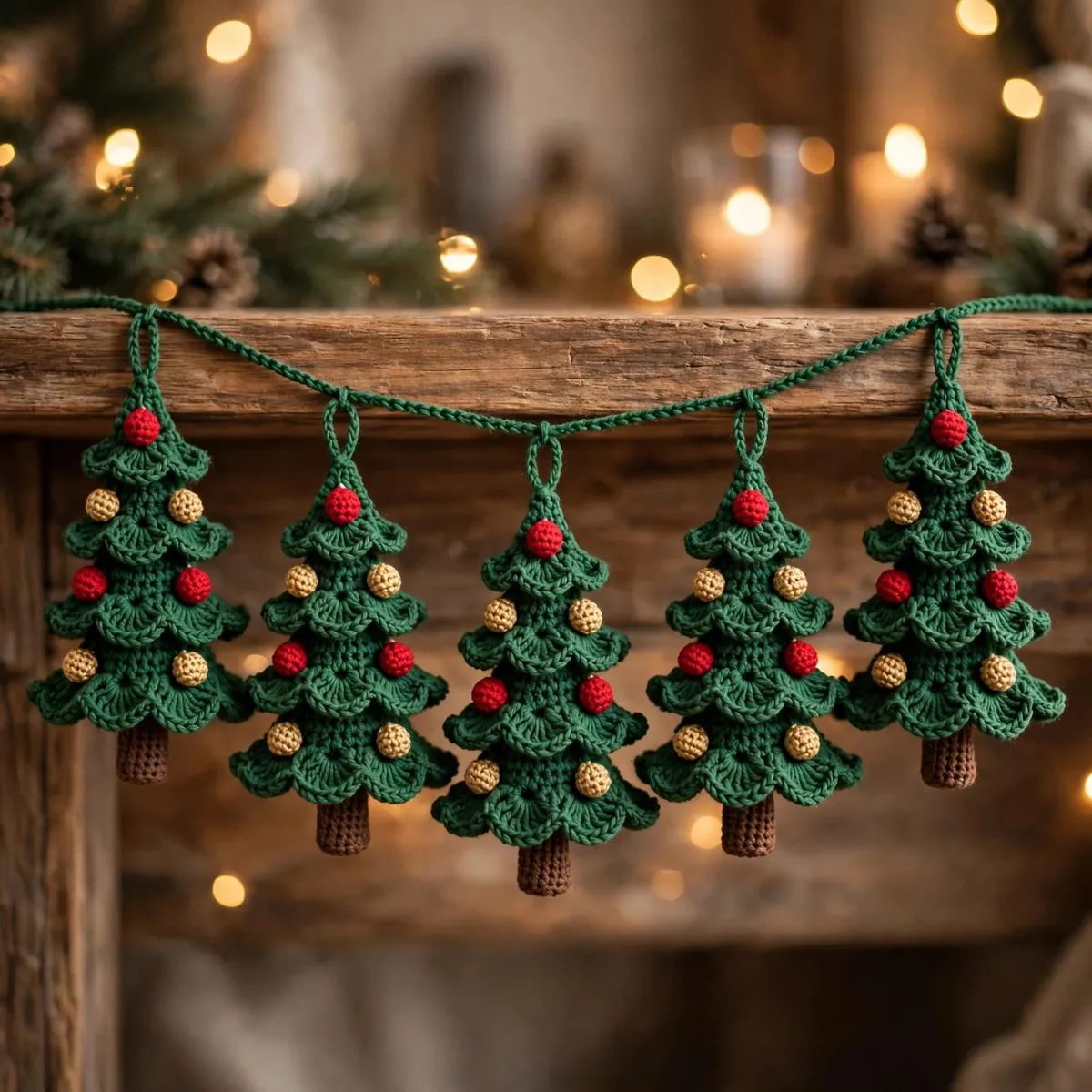
Mini Christmas Tree Garland · LoopSouk pattern
Crochet a garland of five mini Christmas trees in one evening: ruffled tiers, 12 bobble ornaments worked in, no sewing or gluing. Each tree approx. 7.5 cm, cord approx. 80 cm.
≈ $3.00 · instant PDF download
10. Seven mini characters in one bundle
Once you have one small character done, a set is the natural next step. The Christmas amigurumi pattern bundle has a snowman, nutcracker, gingerbread, reindeer, Santa, elf and penguin, each about 8 to 11 cm, all in the same DK yarn with one 3.5 mm hook.
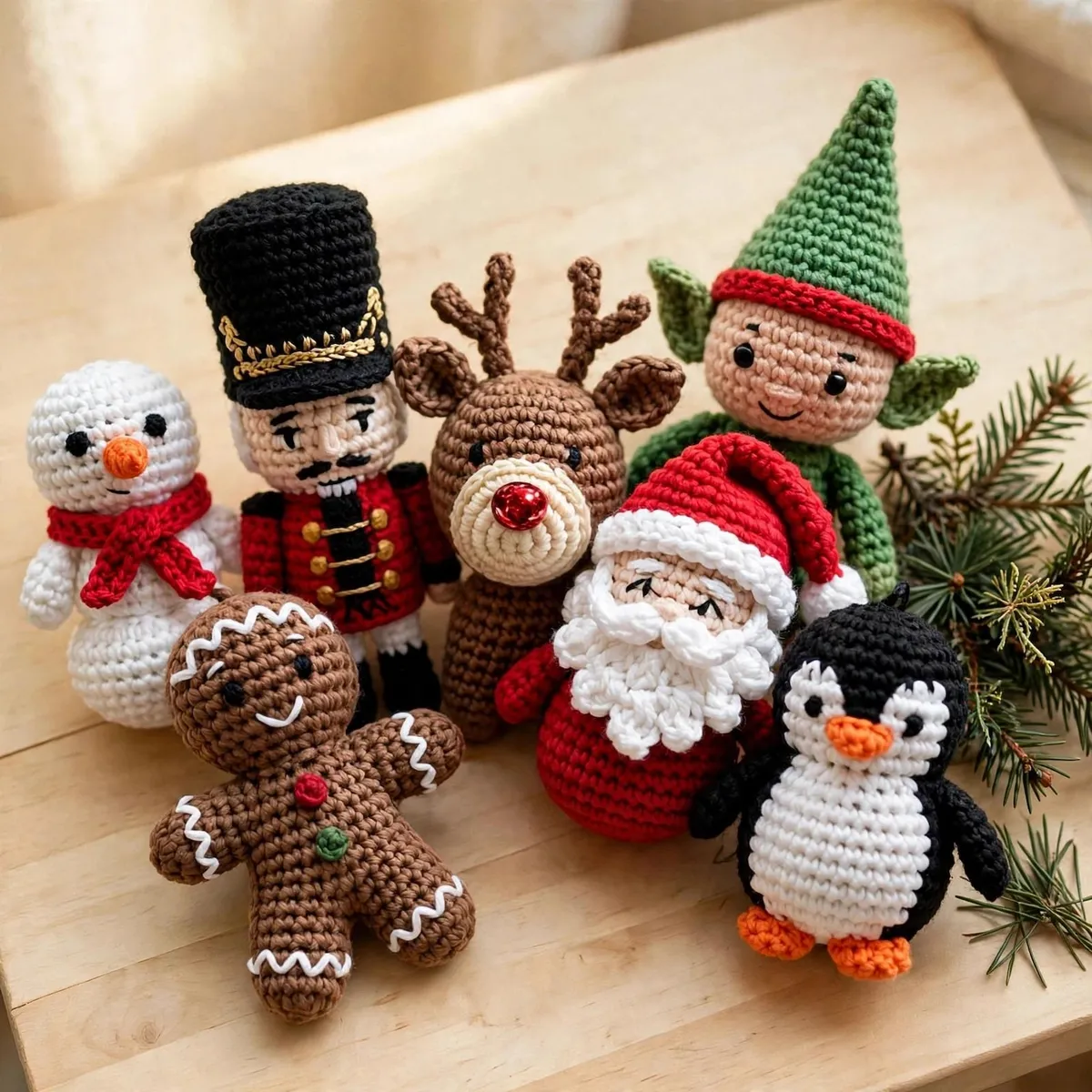
Christmas Minis Bundle (7 in 1) · LoopSouk pattern
Seven beginner-friendly Christmas minis in one 29-page PDF: snowman, nutcracker, gingerbread man, reindeer, Santa, elf and penguin. All DK yarn and one 3.5 mm hook.
≈ $3.00 · instant PDF download
Bonus for confident beginners: Barnaby the gingerbread bear is a 22 to 24 cm plush in super-bulky yarn, a weekend project of roughly 3 to 4 hours, using chain, single crochet, increase, decrease and one bobble stitch.
A simple December plan
Count backwards from when gifts need to be wrapped, not from the 25th. A realistic beginner pace is one small project per evening or two.
- Week 1: practice. Learn the five skills on scrap yarn, then make one small ornament for yourself. Expect it to be imperfect; that one is your tester.
- Week 2: repeat. Make the same ornament two or three more times. Repetition is where speed and neatness come from.
- Week 3: one new project. Try a slightly bigger piece, like a garland or a character.
- Week 4: finish and wrap. Weave in ends, add hanging loops and gift tags. Do not start anything new.
Running late? Our list of crochet stocking stuffers focuses on things you can finish in an evening.
Supplies checklist
- DK (category 3) yarn in red, green, white, brown and a little gold or yellow
- 3.5 mm hook (plus a 6 mm hook if you try a super-bulky project)
- Locking stitch markers
- Fibrefill stuffing
- Safety eyes in small sizes, or black yarn to embroider eyes for gifts for small children
- Yarn needle and small scissors
- Thin ribbon or yarn for hanging loops
Common beginner mistakes (and quick fixes)
- Holes in the fabric: your hook is too big for your tension. Go down half a millimetre or crochet slightly tighter.
- The shape is lopsided: you probably gained or lost a stitch. Count every round against the pattern.
- Decreases leave little gaps: switch to the invisible decrease, worked through front loops only.
- The ornament won't hang straight: attach the loop at the very centre of the top round.
How to read a beginner crochet pattern
Patterns look like code at first, but they follow a predictable format. Each line is usually one round: "Rnd 3: (sc 1, inc) x6 (18)" means work one single crochet, then an increase, repeat that six times, and you should end with 18 stitches. The number in brackets at the end is your checkpoint. If yours doesn't match, stop and recount before going on. Abbreviations are listed at the start of the pattern; US terms (sc for single crochet) are the most common for amigurumi, and LoopSouk patterns are written in US terms. Read the materials list carefully, too: if a pattern was designed in DK yarn and you use worsted, the finished piece will simply come out larger.
FAQ
What is the easiest Christmas thing to crochet?
Flat stars, hearts and simple striped baubles are the easiest. For a 3D character, a small no-sew ornament in DK yarn is a good first step because there is no assembly.
How long does it take a beginner to crochet a Christmas ornament?
A small 5 to 10 cm ornament usually takes a beginner one evening. Your second and third will be noticeably quicker.
What yarn is best for beginner Christmas crochet?
A smooth, light-coloured DK (category 3) acrylic or cotton blend with a 3.5 mm hook. It is easy to see each stitch. Leave fluffy or chenille yarn until you can count stitches confidently.
When should I start crocheting Christmas gifts?
For several gifts, start in October or early November. One evening per small project is a realistic beginner pace, plus time for finishing and wrapping.
Looking for your next project? See every LoopSouk PDF pattern in one place, each with its own article and Etsy link.
Browse all LoopSouk patterns

